
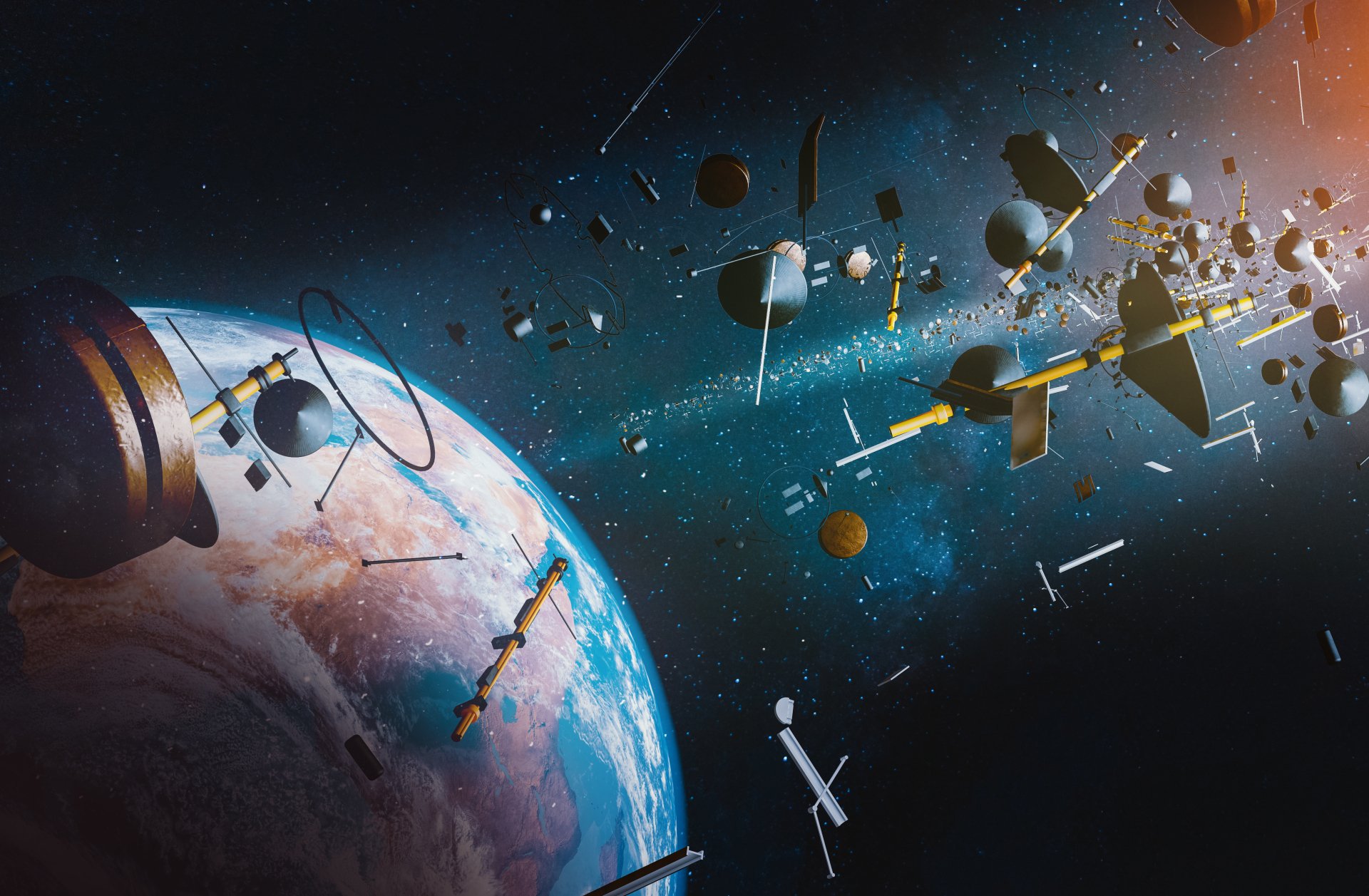
Let’s return to the space junk scenario as it is important to make some clarifications, taking into account that it has been one of my works and campaign to occupy the position of parliamentarian in Asgardia, under the motto: Clean space for all, it is good to contemplate the following:
Space agencies, such as NASA and ESA (European Space Agency), have programs dedicated to monitoring and managing space debris, which represents a growing challenge to the safety of orbital missions. This debris includes inactive satellites, rocket debris, and collision fragments that, if not properly controlled, can damage operating space vehicles and put the lives of astronauts at risk.
As the number of satellites launched into space increases, the need to implement effective solutions becomes even more urgent. Here are some strategies they use: developing technology for tracking and capturing debris, creating international policies for responsible management of space debris and researching innovative methods, such as using nets and lasers to dislodge potentially dangerous objects.
Monitoring: They use telescopes and radars to track objects in orbit, ensuring that space environments remain safe and free of significant risks. The U.S. Space Surveillance Network (SSN) is one of the main networks that tracks more than 20,000 objects, and its ability to detect even the smallest debris is crucial to preventing incidents.
Collision Avoidance: Active satellites have advanced technology that allows them to perform precise manoeuvres to avoid collisions with space debris, thus minimizing the risk of damage to valuable assets in orbit. These manoeuvres are critical, as debris can move at high speeds, turning any collision into a destructive event.
Controlled Deorbiting: Satellites at the end of their useful life can be directed to enter the atmosphere in a controlled manner to burn up, which helps to decrease the amount of debris in orbit and protects other operational satellites. This guaranteed process is part of the regulations that seek sustainability in the use of space.
Cleanup Technologies: Innovative technologies such as nets and harpoons are being developed to capture and remove large debris, along with other approaches such as lasers that can deflect deorbiting objects. These initiatives represent an important step toward mitigating the problem of space debris, ensuring that access to space remains safe and accessible for future generations.
That’s another encouraging point, away from the noise that things aren’t happening properly.
Now, let’s look at the Management of Hazardous Materials by Environmental Agencies. Environmental agencies, such as the EPA (Environmental Protection Agency) in the US, have strict protocols for handling hazardous materials, including radioactive substances. These protocols are critical not only to protect public health, but also to preserve the environment. Here are some key measures: Identification and Classification: Hazardous materials are identified and classified according to their level of risk, which allows for proper management depending on their chemical characteristics and harmful properties.
Containment and Storage: Special containers and secure storage areas are used to prevent leaks and contamination, as well as to ensure that accidents that could result in irreversible damage to the surrounding ecosystem do not occur.
Safe Transportation: Hazardous materials are transported following strict regulations to minimize risks during transit, including the use of suitable vehicles and trained personnel to handle emergencies.
Cleanup and Remediation: In the event of spills or contamination, cleanup and remediation plans are implemented to restore the affected area, involving the use of advanced technologies and specialized techniques that ensure that soil and water are effectively and safely cleaned, guaranteeing the health of both humans and local fauna and flora. In addition, these actions are accompanied by constant evaluations to prevent future incidents and encourage more sustainable practices.
The standard fits perfectly, in the same way, it happens when we buy shoes and we know our size. However, this delicate and necessary work in war zones is not the same. At the moment, it is regrettable that all the fields of cultivation that supply their crops from Ukraine to different parts of the planet are unusable due to contamination by devices called mines.
In a news note, it is pointed out in one of its paragraphs: that 25% of the Ukraine’s agricultural lands are infested with mines and unexploded ordnance, this concerns not only the areas occupied by Russian forces but also the Ukrainian-controlled areas that remained within artillery range.
I would not like to think that this would happen in a futuristic battle in Earth’s orbit, certainly, the analysis comes not only from the mystical phrase: «As above, so below», but from the real circumstances where we repeat scenarios, regardless of the ground or the air, the sea or the land we inhabit.
